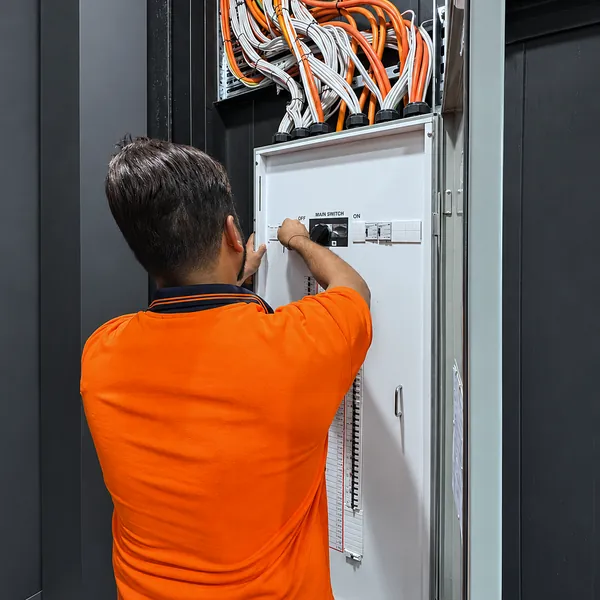
What RCD testing is
A residual current device (RCD), or safety switch, watches the current flowing out and back through a circuit. If some of that current leaks to earth, for example through a person touching a faulty tool, the RCD cuts the power in a fraction of a second. Fast tripping is what stops a shock from being fatal.
RCDs are mechanical devices. Dust, moisture, age and lack of use can make them slow to trip or stop them working at all, and nothing on the outside shows it. Testing is the only way to know an RCD will work when it is needed.
RCD test requirements in South Australia
The rules are in the Work Health and Safety Regulations 2012 (SA).
| Requirement | What it means for you | Regulation |
|---|---|---|
| Use RCDs in hostile environments | Plug-in equipment exposed to damage, moved around or used with amusement devices must be protected by an RCD | 164 |
| Tripping current | For socket outlets up to 20 A, the RCD must trip at no more than 30 mA | 164 |
| Regular testing | RCDs must be tested regularly by a competent person to make sure they are working | 165 |
| Records | Keep a record of each test (other than daily push-button tests) until the next test, or until the RCD is permanently removed | 165 |
| Faulty RCDs | Take a faulty RCD out of service and replace it as soon as possible | Code of practice: managing electrical risks in the workplace |
| Construction sites | Follow AS/NZS 3012 for site electrical installations | 163 |
Regulation 164 does not apply to supplies of 50 V AC or less, to direct current, or where power comes through an isolating transformer or an isolated-winding portable generator that gives equivalent protection.
AS/NZS 3760:2022 is the Australian Standard for in-service testing of electrical equipment, including RCDs. It is guidance rather than law in South Australia, but it sets the test methods and the intervals most workplaces use.
How often RCDs should be tested
The law says “regularly” and leaves the interval to your risk assessment. AS/NZS 3760:2022 sets intervals for two kinds of test, and those intervals depend on the environment and on whether the RCD is portable or fixed. SafeWork SA publishes them in this form:
| Workplace | Push-button test by user, portable | Push-button test by user, fixed | Trip-time test, portable | Trip-time test, fixed |
|---|---|---|---|---|
| Factories, workshops, places of manufacture, assembly, maintenance or fabrication | Daily, or before every use, whichever is longer | 6 months | 12 months | 12 months |
| Equipment or cord flexed in normal use, or in a hostile environment | 3 months | 6 months | 12 months | 12 months |
| Equipment or cord not flexed in normal use, not open to abuse and not in a hostile environment | 3 months | 6 months | 2 years | 2 years |
| Residential type areas, such as hotels, motels, hostels and boarding houses | 6 months | 6 months | 2 years | 2 years |
| Commercial cleaning equipment | Daily, or before every use, whichever is longer | Not applicable | 6 months | Not applicable |
| Construction and demolition sites | After connecting to a socket and before connecting equipment, and at least once every day in use | 1 month | 3 months | 12 months |
As a rule of thumb, the harsher the environment and the more often equipment is moved, the more often its RCD should be tested. Construction sites, workshops and outdoor work sit at the frequent end. Offices sit at the other.
For a fuller explanation, see our guide to how often RCDs should be tested.
Push-button tests and trip-time tests
The push-button test checks that the RCD’s mechanism works. Pressing the “T” or “Test” button creates a small imbalance and the switch should trip. It is quick, anyone can do it, and records of daily push-button tests are not required.
The trip-time test uses an RCD tester to apply a measured fault current and time how long the RCD takes to cut the power. This is the test that shows whether an RCD is fast enough. It is done by a competent person, and the result is recorded.
An RCD that passes the push-button test can still fail the trip-time test, so the two are not interchangeable.
Portable and fixed RCDs
- Portable RCDs plug into a power point and protect whatever is plugged into them. They are common on construction sites and with outdoor equipment, and they are tested and tagged like other portable equipment.
- Fixed RCDs sit in the switchboard and protect whole circuits. Testing them briefly cuts power to those circuits, so we plan the test with you. Replacing a fixed RCD is electrical work for a registered electrical worker.
Tell us whether your RCDs are portable, in the switchboard or both when you book, and we’ll confirm how the fixed ones will be tested.
Who needs RCD testing
Any workplace that relies on RCDs needs them tested, but some need it more often or face closer scrutiny:
- Construction and demolition sites, where leads and tools are moved daily and exposed to weather and damage
- Workshops, factories and warehouses, with heavy equipment, dust and vibration
- Commercial kitchens and cleaning businesses, where water and electricity meet
- Hire companies and event suppliers, whose equipment changes hands constantly
- Schools, childcare, aged care and healthcare, where the people protected may not be able to react to a fault
- Offices and shops, where switchboard RCDs protect every circuit in the tenancy
If you are not sure whether your workplace counts as a hostile environment, we can assess it on the first visit and suggest a test interval to put in your records.
What you get
Every RCD we test is listed in a written record with its location, type, test results, the date and the next test due. Portable RCDs are tagged. Any RCD that fails is reported straight away so it can be taken out of service. RCD testing is often booked with test and tag on the same visit, which saves a second call-out.
Standards and service frequency in SA
| Equipment | How often | Standard | SA source |
|---|---|---|---|
| RCDs on plug-in equipment in hostile environments | Required where equipment is exposed to damaging conditions, moved around or used with amusement devices | WHS Regulations 2012 (SA), regulation 164 (30 mA maximum tripping current, outlets up to 20 A) | SafeWork SA |
| Testing of RCDs | Regularly, by a competent person, with records kept until next test. SafeWork SA's table gives push-button and trip-time intervals by type of workplace | WHS Regulations 2012 (SA), regulation 165, and AS/NZS 3760:2022 (guidance) | SafeWork SA |
| Construction site electrical installations | Throughout construction and demolition work | WHS Regulations 2012 (SA), regulation 163, and AS/NZS 3012 | SafeWork SA |
Who this is for
- Construction sitesWe test and tag site electrical equipment, supply and service fire extinguishers, and help builders put emergency plans in place on Adelaide construction sites.
- Industrial and warehousesWe service the fire safety systems in Adelaide warehouses, factories and industrial sites, from extinguishers and hose reels to hydrants, sprinklers and exit lights, and test and tag the equipment on the floor.
- Commercial officesWe service the fire safety systems in Adelaide offices and commercial buildings, from extinguishers and exit lights to alarms and fire doors, and supply the records behind the owner's Form 3.
- Hospitality and retailWe service the fire safety equipment in Adelaide restaurants, cafés, pubs and shops, from wet chemical extinguishers and fire blankets in the kitchen to exit lights and test and tag.
- Schools and childcareWe service the fire safety equipment in Adelaide schools, kindergartens and childcare centres, and help services prepare for the evacuation rehearsals they must run.
- Aged careWe install and maintain the fire safety systems in Adelaide's Class 9c aged care homes, from sprinklers and monitored smoke detection to exit lighting, fire doors and extinguishers, and supply the records behind your Form 3.
- Healthcare and medicalWe service the fire safety systems in Adelaide medical centres, dental and allied health clinics and other healthcare buildings, and supply the records behind the owner's Form 3.
Certificates and reporting
Every visit ends with a written report listing each item tested, its location and result, and anything that needs attention. Building owners use it as the maintenance record behind their annual Form 3. We are qualified and authorised to carry out fire safety maintenance and sign off SA council ESP Form 2 and Form 3 maintenance documentation.
Ask us for a sample report if you want to see the format before you book.
Who does the work
- FPAS Recognised BusinessFire Protection Accreditation Scheme
- FPA Australia Bronze MemberFire Protection Association Australia
- Engineers AustraliaMember of the national body for engineers
- CBS PGE fire plumbing licenceConsumer and Business Services SA
- Licensed for electrical test and tagAS/NZS 3760 testing


All licences and certificates are held by suitably qualified personnel, and we are fully insured.