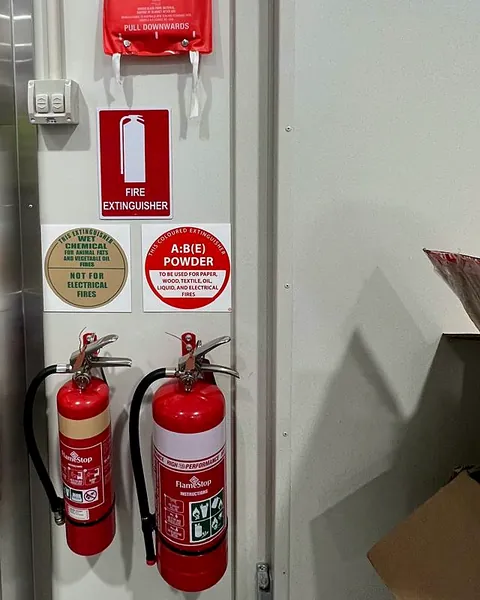
Kitchens are where venues catch fire
In a hospitality venue, the kitchen is the main fire risk: deep fryers, hot oil, open flames, grease in the exhaust and a lot of people working fast. A fire there needs the right response in the first few seconds, and the wrong one, such as water on oil, makes it far worse.
Retail has different risks: stock, packaging, storerooms and crowds who don’t know the building. Both need working equipment, clear exits and staff who know what to do.
Wet chemical extinguishers and fire blankets
Cooking oil and fat fires are Class F fires. The extinguisher made for them is wet chemical, which is red with an oatmeal band. Fire protection guidance published by FPA Australia rates wet chemical as suitable for Class F fires and usable on Class A fires, but dangerous on electrical fires. It rates water as dangerous on cooking oil and fat fires. (FPA Australia fact sheet, via CFA)
Most commercial kitchens have:
- a wet chemical extinguisher near the cooking line
- a fire blanket for small pan fires, mounted on the way to the exit
- a different extinguisher type nearby for electrical equipment and the switchboard
We check each extinguisher matches the hazard beside it and that staff can reach it without reaching over the fryer. See fire extinguishers and our guide to extinguisher types and colours.
Kitchen fire suppression systems
Many commercial kitchens also have a fixed suppression system above the cooking equipment, which discharges automatically when it detects a fire. Tell us the make of your system when you book and we’ll confirm whether we can service it.
What we look after
We service each item on the frequency set by MBS 002 (version 3, May 2023).
| System | How often it is serviced |
|---|---|
| Portable extinguishers | Every 6 months, plus yearly and 5-yearly |
| Fire blankets | Every 6 months |
| Exit and emergency lighting | 6-monthly and yearly, plus monthly checks |
| Detection and alarm | Monthly to 5-yearly |
| Hinged fire doors | Every 6 months |
If your building lodges a Form 3, we supply the maintenance records and sign the contractor section. The owner lodges it with council within 60 business days after the end of each calendar year.
Exits, signs and crowds
Customers don’t know your back corridors. Exit signs and emergency lights show them the way out when the power fails or the room fills with smoke, and they are tested 6-monthly and yearly, with monthly checks. Fire equipment signs help staff find extinguishers fast. At every visit we also report blocked exits and equipment hidden behind stock, kegs or deliveries. See fire safety signs.
Test and tag for venues and shops
Kitchens are hard on electrical equipment: heat, steam, grease and constant cleaning. SafeWork SA sets testing at least every 12 months for hostile environments, where equipment is exposed to moisture, heat, vibration, damage, chemicals or dust, and every 6 months for commercial cleaning. Your risk assessment sets the interval for each area. We test and tag on the same visit as your fire service.
Emergency plans and staff
Every venue needs an emergency plan under WHS regulation 43, covering evacuation, calling 000 and how staff are trained. Casual and rotating staff make that harder, so keep the plan short and walk every new starter through the exits, the extinguishers and the blanket. See evacuation diagrams.
Multi-site groups
Franchise and venue groups can put every site on one schedule, with one report per venue and a summary for head office.
The rules that apply
| Requirement | What it means | Standard | SA source |
|---|---|---|---|
| Portable extinguishers, including wet chemical | Every 6 months, plus yearly and 5-yearly | AS 1851-2012 | MBS 002 v3 (SA) |
| Fire blankets | Every 6 months | AS 1851-2012 | MBS 002 v3 (SA) |
| Emergency and exit lighting | 6-monthly and yearly, plus monthly checks | AS/NZS 2293.2 | MBS 002 v3 (SA) |
| Electrical equipment in hostile environments | At least every 12 months (commercial cleaning every 6 months) | WHS Regulations 150 and 163 to 165, with AS/NZS 3760:2022 as guidance | SafeWork SA |
| Workplace emergency plan | Prepared, maintained and implemented | WHS Regulations 2012 (SA), regulation 43 | SafeWork SA |
What customers say about our hospitality and retail work
“I run a small cafe in the CBD and needed urgent fire extinguisher testing and electrical test and tag for council required ESP Form-3 in Adelaide. These guys were responsive, affordable, and gave us complete peace of mind.