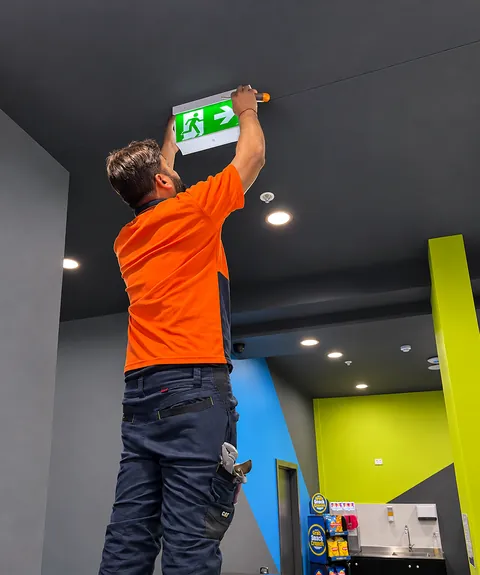
In South Australia, emergency and exit lights are tested every 6 months and every year, with monthly checks in between, under MBS 002 and AS/NZS 2293.2. The test runs each light on battery to prove it will work when the mains power fails.
The green exit sign above the door is easy to ignore until the power goes out and a whole floor of people needs to find the stairs.
That’s the moment emergency lighting has to work, and the only way to know it will is to test it. Emergency lighting testing is a routine compliance task for most commercial, industrial and multi-residential buildings in Adelaide, and it’s easy to let slide because nothing visibly goes wrong when it’s skipped. VD Fire & Electrical tests and services emergency and exit lighting across the city.
Why emergency and exit lighting needs testing
Emergency lights illuminate escape routes when mains power fails, and exit signs mark the way out so people can find it in smoke or darkness. Most rely on batteries that sit idle for months, slowly ageing.
A light that glows on the wall can still have a battery that won’t hold a charge. That’s why exit light testing means running the lights on battery. Checking that they look lit isn’t enough.
Emergency lighting testing intervals in Adelaide
South Australia’s maintenance standard is MBS 002 (version 3, May 2023). For emergency lighting and exit signs it calls up AS/NZS 2293.2, the standard for their inspection, testing and maintenance. The schedule works on three levels: monthly checks between services, a test every 6 months and a yearly service with the extra checks the standard calls for. The exact tasks depend on the type of system, self-contained units or a central battery, so we confirm them for each building.
What emergency exit light testing involves
A full test covers more than flicking a switch. For each building, a technician will typically:
- Check every luminaire and exit sign for damage, dirt and obstruction, and clean where needed.
- Confirm the charge indicators are working.
- Make sure units are fully charged before the test begins.
- Isolate the emergency lighting circuit to simulate a power failure.
- Check that every light operates on battery and stays lit for the full test period.
- Restore power and confirm the units return to charging.
- Replace failed batteries, lamps or units, or quote for them.
- Record the date, results and any faults.
Because the test deliberately cuts power to the emergency lighting circuits, we plan it around your operating hours and keep building management informed. When you book a test, tell us your building’s operating hours and we’ll plan around them.
Standards and compliance requirements for emergency lighting maintenance in Adelaide
AS/NZS 2293.2 covers routine service and maintenance, and AS/NZS 2293.1 covers design and installation. The National Construction Code sets out which buildings need emergency lighting in the first place, and requires it to comply with AS/NZS 2293.1.
Emergency lighting and exit signs are essential safety provisions. Your building’s Form 1, the schedule of ESPs issued by council or the relevant authority, lists what your building has. The test records are the evidence behind the owner’s annual Form 3, lodged with council within 60 business days after the end of each calendar year. Smaller buildings exempt from lodging must still maintain their ESPs.
A logbook is the other half of compliance. Test dates, results, faults found and repairs made should all be recorded and kept ready to show a council officer, auditor or insurer. Under regulation 94 of the Planning, Development and Infrastructure (General) Regulations 2017, owners must produce up to 2 years of maintenance records within 48 hours if an authorised officer asks, and not maintaining ESPs carries a $750 expiation. The bigger problem is that without testing you won’t know whether the lights will work when they’re needed.
Signs your exit lights need testing sooner
A few things are easy to spot without any technical knowledge:
- Lights that flicker, look dim or don’t come on during a brief power blip.
- Charge indicators that are off, flashing or showing a fault.
- Cracked, yellowed or damaged diffusers, or exit signs that are hard to read.
- Units whose batteries have never been replaced and are several years old.
- Lights that were disturbed during renovations or repainting.
If you notice any of these, don’t wait for the next scheduled visit.
Emergency lighting is the part of your fire safety system you hope never to use, which is why it needs testing on a schedule. Monthly checks, a 6-monthly and yearly service and an up-to-date logbook keep it ready. If yours is overdue, call VD Fire & Electrical on 08 8151 1040 or see our emergency and exit lighting testing service. Our annual fire safety checklist shows how it fits with the rest of your building’s servicing.