What our sprinkler maintenance covers
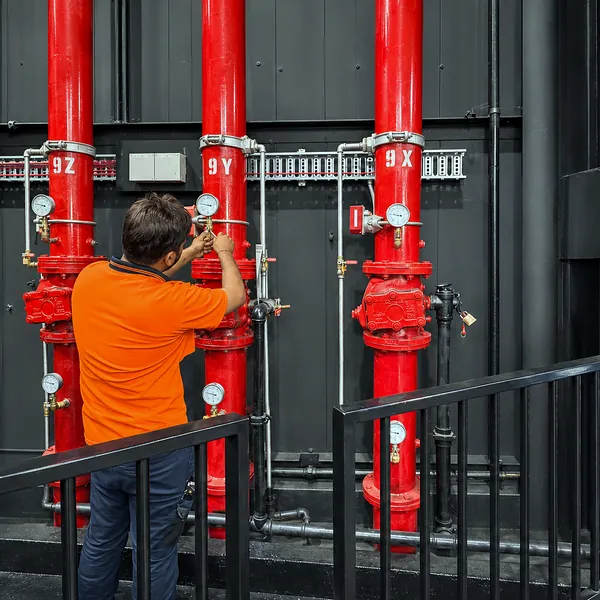
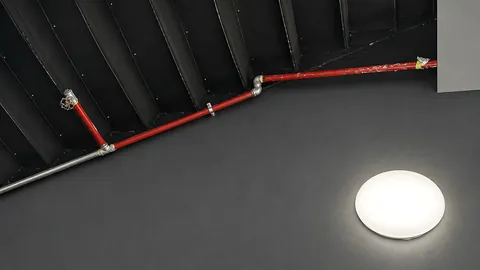
Sprinkler maintenance is about making sure water reaches a fire when a sprinkler head opens. Our technician checks the main sprinkler valve set, gauges and alarm devices, confirms valves are in their correct open or closed position and secured, and tests that the alarm operates when water flows. Sprinkler heads and pipework are inspected for damage, corrosion, paint and obstruction, such as stock stacked too close or a new partition that blocks the spray.
Where the system has a fire pump or a fire water storage tank, those are maintained as part of the same plan. You get a written report covering every part of the system, its result and anything that needs repair. Building owners use it as the maintenance record behind their annual Form 3.
Fire pumps
Many sprinkler and hydrant systems need a pump to reach the pressure they were designed for. A pump that won’t start, or starts but can’t hold pressure, defeats the whole system. Pump maintenance includes regular test runs, checks of the controller, power supply or engine, and performance testing at the longer intervals. Tell us whether your pump is diesel or electric when you book.
Sprinkler system installation
We also install fire sprinkler systems, along with the fire hydrants that often share the same water supply. The work is done by suitably qualified personnel. We hold a CBS PGE fire plumbing licence and are FPAS accredited. Before a new building is occupied, the installer signs a Form 2 for the essential safety provisions it installed, and we are authorised to sign off ESP Form 2 documentation.
Installation is quoted per project. Send us the building plans, the Form 1 schedule or the approval documents that say what the building needs, and tell us whether the site has a fire water storage tank or pump. Once a system is in, we can maintain it on the same schedule as the rest of your essential safety provisions.
Fire water storage tanks
Where the town main can’t supply enough water on its own, a fire water storage tank holds a dedicated supply for sprinklers or hydrants. We check the water level, the tank and its fittings, the valves and the inlet supply, and record any leaks, corrosion or debris. The longer-interval inspections look more closely at the tank’s condition.
Our fire hydrant and booster testing page covers the hydrant side of a shared supply.
Service intervals
AS 1851-2012 sets separate routines for sprinkler systems, fire pumps and water storage tanks. Some checks are frequent, others are yearly or longer. We set up a schedule for your site that covers every routine and record each visit.
Who can test your sprinklers
In South Australia, testing firefighting equipment connected to mains water needs a test and inspect registration from Consumer and Business Services (CBS). Annual and longer tests also need plumbing registration. The only exception to the plumbing rule is hose reels.
We hold a CBS PGE fire plumbing licence and are FPAS accredited (Fire Protection Accreditation Scheme). Our licences are held by suitably qualified personnel. Ask us which registrations apply to the tests on your system.
Which buildings have sprinklers
Your Form 1 schedule of essential safety provisions lists what your building must have. Some rules come from the building’s class under the NCC:
- Aged care (Class 9c): sprinklers throughout, plus smoke detection connected to monitoring.
- Residential care (Class 3): sprinklered throughout. South Australia defines a residential care building as one where 10% or more of residents need help to evacuate.
- SDA: the SDA Design Standard calls sprinklers “desirable”, not mandatory. Whether an SDA home needs them depends on its building class.
NCC 2022 applies in South Australia until 30 April 2027, and NCC 2025 starts on 1 May 2027.
Sprinklers and your Form 3
If your building lodges a Form 3, the owner signs it each year to confirm the essential safety provisions have been maintained, and lodges it with council within 60 business days after the end of each calendar year. We supply the maintenance records behind it and sign the contractor section. Councils cite $750 expiations for not lodging or not maintaining, and up to $10,000 if prosecuted.
Between services
Sprinkler systems are designed around the building as it was approved. Changes made between services can stop them working as intended:
- Don’t paint, cover or hang anything from sprinkler heads or pipework.
- Keep stock and storage below the heads, with clear space for the spray. Ask us if you are unsure how much.
- Tell us before a fit-out, new partitions, a new mezzanine or a change in what is stored. Any of these can affect coverage.
- Don’t close a sprinkler valve without telling us and your monitoring provider.
- Report leaks, damaged heads and pump alarms straight away.
Booking your first service
Send us your Form 1 schedule of essential safety provisions, your last service reports or logbook, and any system plans or block plans you have. Tell us who can give access to the valve room, pump room and tank. Call 08 8151 1040 to book.
Standards and service frequency in SA
| Equipment | How often | Standard | SA source |
|---|---|---|---|
| Automatic fire sprinkler systems | Routine intervals set by AS 1851-2012 | AS 1851-2012 | MBS 002 v3 (SA) |
| Fire pumps and fire water storage tanks | Routine intervals set by AS 1851-2012 | AS 1851-2012 | MBS 002 v3 (SA) |
| Who may test mains-connected sprinkler systems | Every test. Yearly and longer tests also need plumbing registration | CBS test and inspect registration, plus plumbing registration for yearly and longer tests | Consumer and Business Services (CBS), SA |
| Class 9c aged care and Class 3 residential care buildings | Sprinklers required throughout | NCC 2022 E1D10 (Class 9c) and E1D7 (Class 3 residential care) | NCC, Advisory Notice 01/24 (SA) |
Who this is for
- Aged careWe install and maintain the fire safety systems in Adelaide's Class 9c aged care homes, from sprinklers and monitored smoke detection to exit lighting, fire doors and extinguishers, and supply the records behind your Form 3.
- SDA and NDIS homesWe set up and maintain the fire safety in Specialist Disability Accommodation (SDA) and supported independent living (SIL) homes across Adelaide, from fire risk assessments and the move-in package to 6-monthly servicing and audit-ready records.
- Industrial and warehousesWe service the fire safety systems in Adelaide warehouses, factories and industrial sites, from extinguishers and hose reels to hydrants, sprinklers and exit lights, and test and tag the equipment on the floor.
- Commercial officesWe service the fire safety systems in Adelaide offices and commercial buildings, from extinguishers and exit lights to alarms and fire doors, and supply the records behind the owner's Form 3.
- Strata and apartmentsWe maintain the fire safety systems on the common property of Adelaide strata and community title buildings and supply the records the corporation needs for its annual Form 3.
- Healthcare and medicalWe service the fire safety systems in Adelaide medical centres, dental and allied health clinics and other healthcare buildings, and supply the records behind the owner's Form 3.
Certificates and reporting
Every visit ends with a written report listing each item tested, its location and result, and anything that needs attention. Building owners use it as the maintenance record behind their annual Form 3. We are qualified and authorised to carry out fire safety maintenance and sign off SA council ESP Form 2 and Form 3 maintenance documentation.
Ask us for a sample report if you want to see the format before you book.
Who does the work
- FPAS Recognised BusinessFire Protection Accreditation Scheme
- FPA Australia Bronze MemberFire Protection Association Australia
- Engineers AustraliaMember of the national body for engineers
- CBS PGE fire plumbing licenceConsumer and Business Services SA
- Licensed for electrical test and tagAS/NZS 3760 testing


All licences and certificates are held by suitably qualified personnel, and we are fully insured.