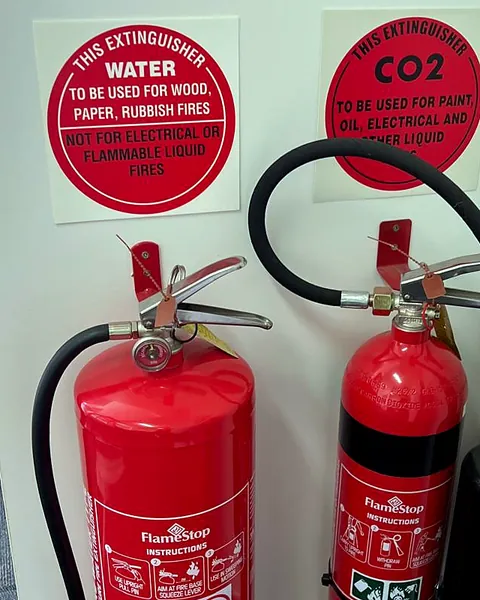
Australian fire extinguishers are red, and the coloured band or label tells you what is inside: none for water, blue for foam, white for powder, black for CO2, oatmeal for wet chemical and yellow for vaporising liquid. The rating panel on the label shows which classes of fire each one suits, so read both before you use it.
Our main source is the FPA Australia fact sheet Fire Extinguishers: Types & Uses, published by FPA Australia in 2009 and hosted by CFA. The label on your own extinguisher always has the final say.
The classes of fire
Australia groups fires into six classes, by what is burning:
| Class | What is burning | Examples |
|---|---|---|
| A | Ordinary combustibles | Paper, wood, cardboard, fabric, many plastics |
| B | Flammable and combustible liquids | Petrol, diesel, solvents, paint |
| C | Flammable gases | LPG, natural gas |
| D | Combustible metals | Magnesium, aluminium swarf, some industrial metals |
| E | Electrically energised equipment | Switchboards, computers, appliances while powered |
| F | Cooking oils and fats | Deep fryers, pans of oil |
Every extinguisher label lists the classes it is rated for. Some types are worse than ineffective on certain classes. They are dangerous. That is the main reason to know the colours.
Extinguisher colours and what each type is for
| Type | Colour | Rated for | Not for |
|---|---|---|---|
| Water | Solid red | Class A | Dangerous on electrical (E) and cooking oil (F) fires. Not effective on B or C |
| Foam | Red with a blue band | Class A and B (limited on F) | Dangerous on electrical (E) fires. Not effective on C |
| Powder (ABE) | Red with a white band | Class A, B, C and E | Not effective on cooking oil (F) fires |
| Powder (BE) | Red with a white band | Class B, C and E | Check the label for other classes |
| Carbon dioxide (CO2) | Red with a black band | Class E | Only limited effectiveness on A, B and F |
| Wet chemical | Red with an oatmeal band | Class F, and may be used on A | Dangerous on electrical (E) fires. Not effective on B or C |
| Vaporising liquid | Red with a yellow band | Class A and E (limited on B) | Not effective on F |
Class D metal fires need special-purpose extinguishers. If your process involves combustible metals, get specialist advice for that hazard.
Choosing the right type for each area
Most buildings need more than one type, because the hazards change from room to room. As a starting point:
- Offices and general areas: ABE powder covers most fires you’d expect.
- Switchboards, server rooms and electrical plant: CO2 or vaporising liquid, both rated for Class E. See which extinguisher to use on an electrical fire.
- Commercial kitchens: wet chemical by the cooking line, with a fire blanket.
- Home kitchens: a fire blanket and an extinguisher near the kitchen entrance, away from the stove, as the MFS recommends.
- Workshops and fuel stores: powder or foam for flammable liquids.
In a building with essential safety provisions, the extinguishers on site should match its Form 1 schedule. When we supply and install extinguishers, we match each one to the hazard beside it.
Reading the label
The colour band is a quick guide, not the whole story. Before using an extinguisher, read the label. It shows the agent, the classes the extinguisher is rated for, its rating and how to use it. The FPA fact sheet notes that the colours apply to extinguishers marketed in Australia. On aircraft, ships, some industrial sites and overseas you may find other colour schemes. Our guide on how to use a fire extinguisher covers the steps once you’ve picked the right one.
Each extinguisher also carries a service tag. In South Australia, MBS 002 calls up AS 1851-2012, which sets a 6-monthly inspection with yearly and 5-yearly services. If the tag is out of date, the extinguisher may not work. See fire extinguisher testing.
Old colours and banned extinguishers
The FPA fact sheet says the standard colours of some extinguishers changed in 1999. Foam used to be solid blue and wet chemical used to be oatmeal all over. Both are now red with a coloured band, so you may find two styles of the same type on one site. Both are fine if they are in date.
Halon 1211 (BCF) extinguishers are a different matter. Halon depletes the ozone layer, and unless a special exemption applies, BCF extinguishers are banned and should be returned to a fire protection supplier or the fire brigade. If you find one in a shed or an old fit-out, don’t use it. Ask us to take it away.
Extinguishers and lithium-ion batteries
People often ask which extinguisher to use on a lithium battery fire. CFA’s July 2026 fact sheet, Lithium-ion batteries and fire extinguishers, says there is currently no Australian Standard for testing an extinguisher’s success on lithium-ion battery fires, and CFA will not sell or service extinguishers marked for them until there is. Its advice if a battery smokes or flames is not to touch it, to evacuate and close doors if safe, and to call 000 and say it is a lithium-ion battery incident.
Signs above extinguishers
A location sign above each extinguisher helps people find it quickly, and many signs show the extinguisher type. When an extinguisher is swapped for a different type, the sign should change too. See fire safety signs.
If you’re not sure the extinguishers on your site are the right ones, call VD Fire & Electrical on 08 8151 1040. We check the type against the hazard at every service.