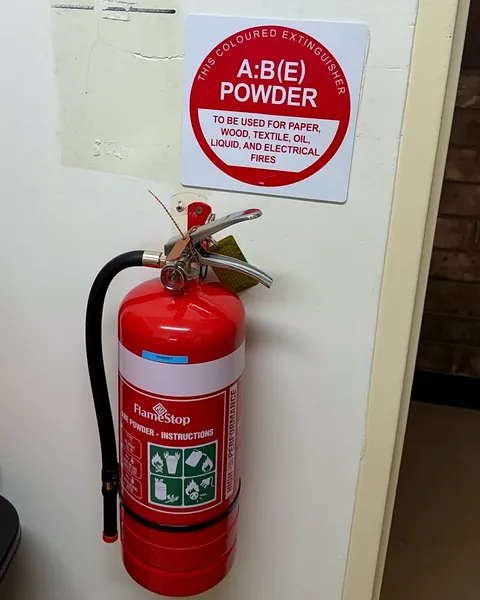
To use a fire extinguisher, remember PASS: pull the pin, aim at the base of the flames, squeeze the trigger and sweep from side to side. Use it only on a small fire, with your way out behind you, and only after the alarm has been raised.
The steps and limits below come from the South Australian Metropolitan Fire Service (MFS) fact sheet Extinguishing a Fire. The instructions printed on your own extinguisher always come first.
What does PASS stand for?
- P is for pull. Pull the pin.
- A is for aim. Aim the nozzle at the base of the flames, where the fuel is burning.
- S is for squeeze. Squeeze the trigger while holding the extinguisher upright.
- S is for sweep. Sweep the nozzle from side to side, covering the base of the fire.
Once the flames are out, keep watching. The MFS warns that a fire may re-ignite after it seems to be out.
Work quickly. The MFS says a small extinguisher may empty in as little as 8 seconds, and a larger one in up to 60 seconds.
When should you use a fire extinguisher?
An extinguisher is a first-attack tool for the early stages of a fire. According to the MFS, before you try to put a fire out:
- don’t put your life at risk
- call for support, and have someone else call 000 for the fire service
- make sure everyone else has been evacuated
- make sure you have the right extinguisher, especially if electricity or burning fat is involved
The right extinguisher is the one rated for what is burning. Water is for wood, paper and fabric. It is dangerous on electrical and cooking oil fires. Check the label, or see our guides to fire extinguisher types and colours and which extinguisher to use on an electrical fire.
Read the instructions on your extinguisher before you need them. The MFS says an emergency is not the time to read extinguisher instructions, so look at the label each time you check the extinguisher.
When should you leave instead?
The MFS says do not use, or keep using, an extinguisher if:
- you are putting your life at risk
- the fire is larger than a waste paper basket
- the fire is spreading quickly beyond where it started
- the extinguisher is having no effect, or is making the fire worse
- you can’t put the fire out quickly, within about 30 seconds
- you don’t know what is burning
If any of those apply, close the door on the fire, make sure everyone is out, and call 000 from a phone outside the building. Never go back in. Wait to meet the fire service. In the MFS’s words, saving lives through a quick escape is far more important than saving property.
Where should you stand when using an extinguisher?
The MFS fact sheet doesn’t give a distance in metres. Its rule is about position: keep your escape path at your back, and never let the fire get between you and the way out. Stand where the discharge reaches the base of the fire, and back away towards your exit if the heat or smoke builds. Your extinguisher’s label shows how to operate it, so read it before you need it.
If you are outdoors, or the fire is in a vehicle, the MFS says to stand upwind of the fire.
What is the fire triangle?
The fire triangle is the idea that fire needs three things at once: oxygen, fuel and heat. The MFS explains that oxygen makes up 21% of the air, fuel can be anything from paper and furniture to petrol, gas and cooking oil, and heat starts the fire and then keeps it going. The chemical chain reaction between them is sometimes called the fourth element.
Take away any one of them and the fire goes out. The MFS describes four ways to do that:
| Method | How it works | Example |
|---|---|---|
| Starving | Remove the fuel | Turning off the gas on a gas fire |
| Smothering | Keep oxygen away from the fuel | A fire blanket over a pan |
| Cooling | Bring the burning material below its ignition point | Water on burning wood or paper |
| Breaking the chain reaction | Interrupt the chemistry of the fire | Dry chemical powder, which also smothers |
That is why extinguisher types differ. Each one attacks a different side of the triangle, and some are unsafe on certain fuels.
Special cases from the MFS
- Oven fire. Don’t open the oven door. Turn off the heat and call 000.
- Car fire. Turn off the ignition and apply the handbrake, have someone call 000, stand upwind and watch for traffic. For an engine fire, pop the bonnet but do not open it, and fire the extinguisher through the gap.
- Pan of oil. A fire blanket is the safest way to put out a contained cooking fire. See how to use a fire blanket.
After you’ve used an extinguisher
Watch the area for re-ignition until the fire service arrives. Don’t hang a used or partly used extinguisher back on the wall. Have it serviced or replaced before you rely on it again, and tell whoever looks after your fire equipment.
At home, the MFS says to check a dry powder extinguisher at least every 6 months: shake it gently, check the gauge is in the green and look for damage. In a workplace, see our fire extinguisher testing service.
Training makes the difference
Most people have never pulled the pin on an extinguisher. SafeWork SA’s emergency response guidance says emergency training can cover the use of emergency equipment, and that roles such as fire or floor wardens need specific training. Its code of practice asks whether workers are trained to use emergency equipment such as fire extinguishers.
VD Fire & Electrical services extinguishers across Adelaide from $9 + GST each and supplies the right type for each hazard. See fire extinguisher testing or call 08 8151 1040.