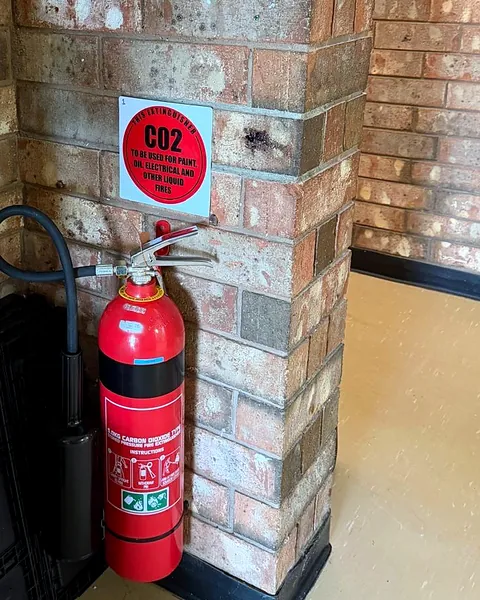
The extinguisher to use on an electrical fire is a CO2 (black band) or a dry powder rated ABE or BE (white band). Water, foam and wet chemical extinguishers are dangerous on live electrical equipment, so never use them on a fire in a switchboard, power board or appliance that is still plugged in.
South Australia’s Metropolitan Fire Service (MFS) puts it plainly in its electrical hazards fact sheet: never use water to extinguish an electrical fire, and use a dry powder extinguisher with an ABE or BE rating or a carbon dioxide extinguisher instead.
What is a Class E fire?
Australia groups fires into classes by what is burning. The MFS fact sheet Extinguishing a Fire defines Class E as fires involving energised electrical equipment. That covers a smoking power board, a burning heater or computer that is still connected, or a fault inside a switchboard.
Every extinguisher label lists the classes it is rated for. Look for the letter E before you rely on it for an electrical fire.
Which extinguishers are safe on electrical fires?
These are the types FPA Australia’s fact sheet Fire Extinguishers: Types & Uses lists as suitable for Class E fires.
| Type | Colour band | Electrical (E) | Other notes |
|---|---|---|---|
| Carbon dioxide (CO2) | Black | Suitable | Limited effectiveness on Class A, B and F fires |
| Dry powder, ABE | White | Suitable | Also suits Class A, B and C. Not effective on cooking oil (F) |
| Dry powder, BE | White | Suitable | Also suits Class B and C. Limited on cooking oil (F) |
| Vaporising liquid | Yellow | Suitable | Also suits Class A. Not effective on cooking oil (F) |
Powder labels look alike, so read yours. CFA’s fire extinguisher guide for business owners says to look carefully to see whether a unit is BE or ABE, because the capability is different. The same guide notes that CO2 is not suitable for outdoor use or for smouldering, deep-seated Class A fires.
For the full colour chart, see our guide to fire extinguisher types and colours.
Which extinguishers must never be used on electrical fires?
The FPA fact sheet describes three common types as dangerous on electrically energised equipment:
- Water (solid red). The MFS also says never to use water on an electrical fire.
- Foam (red with a blue band).
- Wet chemical (red with an oatmeal band). It is made for cooking oil fires, and is dangerous on electrical equipment.
This matters most in kitchens, where a wet chemical extinguisher often hangs near appliances and power points. If a fryer is on fire, wet chemical is right. If the toaster or the switchboard is on fire, it is the wrong choice.
Should you switch off the power first?
Only if you can do it safely. Queensland’s fire service, in its Safe Home checklist, says to know where your switchboard is because you may need to turn off the power in an emergency. For a fire in a microwave it says to turn the appliance off and, if safe, unplug it.
The MFS rules for tackling any fire apply here too:
- Don’t put your life at risk.
- Have someone else call 000 whenever possible.
- Make sure everyone else is out.
- Keep your escape path at your back, and never let the fire get between you and the way out.
So if the switchboard is past the fire, or you would have to reach through smoke or flames to get to the power point, leave it. Get out, close the door and call 000.
What to do if an appliance or power board catches fire
- Raise the alarm and have someone call 000.
- If you can reach it safely, turn the appliance off at the power point or switch off at the switchboard.
- If the fire is small, use a CO2 or ABE or BE powder extinguisher. Aim at the base of the fire using the PASS method in our guide to how to use a fire extinguisher.
- Stop and leave if the fire is bigger than a waste paper basket, is spreading, or isn’t going out within about 30 seconds. These are the MFS limits.
- Close the door behind you, stay out and wait for the fire service.
Afterwards, don’t switch the circuit back on or use the appliance until it has been checked. The MFS says a qualified electrician must carry out all work on the electrical system of a house.
Which extinguisher suits your home or workplace?
For homes, the MFS fact sheet Fire Extinguishers for Domestic Use recommends a B:E dry powder extinguisher rated at least 5B:E, which covers flammable liquid, electrical and cooking oil fires. An A:B:E powder rated at least 1A:5B:E is also suitable, but it has limited effect on cooking oil, so the MFS says to pair it with a fire blanket in the kitchen. Mount extinguishers near the kitchen exit.
In a workplace, match each extinguisher to the hazard beside it. A switchboard room, a server cupboard and a workshop full of powered tools each suit a Class E rated extinguisher. Vaporising liquid units have their own servicing rule: CFA’s guide says their 5-yearly service must be done by people holding ODS and SGG licences. SafeWork SA’s code of practice on the work environment asks whether your fire protection equipment suits the risks at your workplace and whether workers are trained to use it.
How to stop electrical fires starting
The MFS lists the common causes as overloaded circuits, faulty equipment and misuse of electrical equipment. Its tips include:
- Use power boards with overload cut-out switches, and never plug power boards into each other.
- Don’t run cords under rugs or furniture, where heat builds up and damage stays hidden.
- Unwind cords fully before use.
- Replace frayed, cracked or scorched cords, or throw the appliance out.
- Fit RCDs (safety switches) to all circuits.
In a workplace, regular inspection and testing of plug-in equipment finds damaged leads before they fail. See test and tag and our guide to RCD testing.
VD Fire & Electrical supplies the right extinguisher for each hazard across Adelaide, and extinguisher servicing starts from $9 + GST per extinguisher. See fire extinguisher supply and installation or call 08 8151 1040.