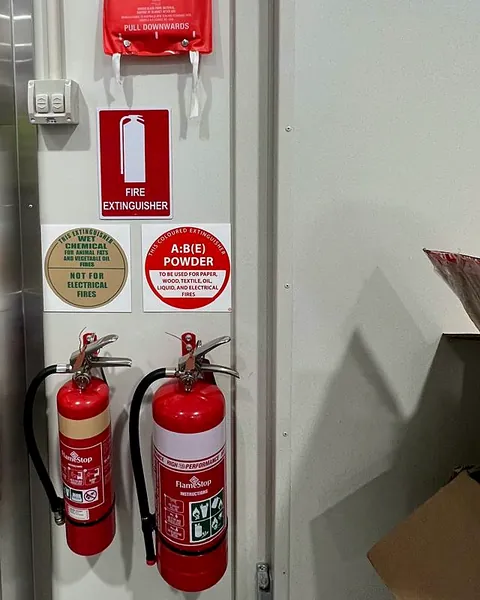
A wet chemical extinguisher is the one made for fires in cooking oil and fat, known as Class F fires. In a cafe or restaurant kitchen it belongs near the fryers and cooktops, with a fire blanket close by. Water must never go near burning oil, and wet chemical must never be used on live electrical equipment.
What is a Class F fire?
The South Australian Metropolitan Fire Service (MFS) defines Class F as fires involving cooking oils and fats, in its fact sheet Extinguishing a Fire. In a commercial kitchen that means deep fryers, woks, pans of oil and fat-soaked cooking surfaces.
Cooking oil fires have their own class for a practical reason. Some extinguishers that work well on paper or timber do little against hot oil, and some make it far worse.
What is a wet chemical extinguisher?
According to FPA Australia’s fact sheet Fire Extinguishers: Types & Uses, a wet chemical extinguisher:
- is red with an oatmeal band or label (older units were oatmeal all over)
- is suitable for Class F fires, and may be used on Class A fires
- is not considered effective on Class B (flammable liquid) or Class C (gas) fires
- is dangerous if used on Class E fires, which involve energised electrical equipment
That last point matters in a kitchen full of appliances, power points and a switchboard. Wet chemical is for the fryer, not the toaster. For electrical risks, keep a CO2 or ABE or BE powder extinguisher as well. See our guide to which extinguisher to use on an electrical fire.
Why must water never be used on a cooking oil fire?
Because it turns a pan fire into a fireball. The MFS fire blankets fact sheet explains that water turning to steam expands so suddenly that it throws the burning liquid out of the container, setting fire to anything it lands on. Its cooking safety fact sheet says to never throw water onto an oil or fat fire.
That rule covers water extinguishers too. FPA Australia describes a water extinguisher (solid red) as dangerous on cooking oils and fats. In a busy kitchen, the quickest thing to hand is often a jug or a hose at the sink, so this belongs in every new starter’s induction.
How do the other extinguisher types compare on Class F fires?
| Type | Colour band | Cooking oil and fat (F) |
|---|---|---|
| Wet chemical | Oatmeal | Suitable |
| Powder, BE | White | Limited effectiveness |
| Foam | Blue | Limited effectiveness |
| CO2 | Black | Limited effectiveness |
| Powder, ABE | White | Not considered effective |
| Vaporising liquid | Yellow | Not considered effective |
| Water | Solid red | Dangerous |
These ratings are from the FPA fact sheet. CFA’s fire extinguisher guide for business owners is stricter on CO2 and marks it as not suitable for cooking oil fires. Either way, CO2 is not the extinguisher to reach for at the fryer.
Where do fire blankets fit?
A fire blanket smothers a contained oil fire, such as a pan on a cooktop. CFA’s fire blanket guide for business owners says to mount the blanket near the doorway to the kitchen, away from the stove, so a stove-top fire doesn’t block your way to it and you can still get out if the fire grows. It also says a blanket must be replaced after use. For the full steps, see how to use a fire blanket.
What should staff do when a fryer or pan catches fire?
Queensland’s fire service, in its Safe Home checklist, gives simple advice for a cooking oil fire: don’t use water and don’t pick up the pot. Turn off the heat, put the lid on or use a fire blanket, and don’t remove it until the pot has cooled completely. If the fire has spread beyond the cooktop, evacuate and call 000.
Add the MFS rules for using any extinguisher. Raise the alarm and have someone call 000, keep your escape route behind you, and stop if the fire is bigger than a waste paper basket or isn’t going out within about 30 seconds. Read the operating instructions on your wet chemical extinguisher before you need them. CFA’s guide asks whether they are clear and legible, and whether staff have been trained.
Even if the fire goes out, call 000. The MFS says a cooking fire can spread into the range hood or the ceiling through the exhaust fan.
How do you stop kitchen fires starting?
The MFS cooking safety advice applies to every kitchen:
- Never leave the cooking unattended, especially with high heat, fats or oils.
- Heat cooking oil slowly.
- Clean grease and oil from cooking surfaces regularly.
- Clean the range hood filters regularly so they don’t catch fire and spread it.
- Keep tea towels and oven mitts off and away from the cooktop.
- Wear short or close-fitting sleeves.
Servicing wet chemical extinguishers and blankets
Wet chemical extinguishers and fire blankets in a commercial kitchen are serviced like the rest of your fire equipment. In South Australia, MBS 002 calls up AS 1851-2012, which sets 6-monthly, yearly and 5-yearly services for extinguishers and a 6-monthly service for fire blankets. CFA’s guides say both should carry a maintenance tag showing the servicing is done.
Your workplace emergency plan comes into it too. SafeWork SA’s code of practice on the work environment asks whether your fire equipment suits the risks at your workplace and whether workers are trained to use it. See fire extinguisher testing and emergency management plans.
VD Fire & Electrical supplies and services wet chemical extinguishers and fire blankets for cafes and restaurants from the Adelaide CBD to Norwood and Glenelg, with extinguisher servicing from $9 + GST. See hospitality and retail or call 08 8151 1040.